|
|
Citizen Queen is the latest perfume to come out from the confidential French label Juliette Has A Gun and out of the hands of perfumer Francis Kurkdjian. It was released in France in May 2008 and will be shortly in the US. For the founder of the brand, Romano Ricci, the gun that a woman aims at a man today cannot but be her perfume. So how does this Juliette's pistol smell like? Citizen Queen - visibly a play of words on Orson Welles's Citizen Kane in tune with the pop culture references of the house - is presented as an aldehydic chypre (a classic chypre accord rests on notes of bergamot, oakmoss, cistus-labdanum, patchouli, and I am tempted to add amber although the Société Française des Parfumeurs does not list it). The scent wishes to be an incarnation of contemporary femininity, which it does with a vintage flair. To this effect and to my nose, it seems to artfully borrow from several classical sources of inspiration that together read like a list of 20th century feminine fragrance best-sellers: YSL Paris, Rochas Madame Rochas, Femme, Chanel No. 5, Guerlain Mitsouko, Coty Chypre are all contained in this jus at some level. As one can see Citizen Queen is a perfume that comes with a solid background in the classics. It is very frequent in the world of perfumes to practice this type of classics-revisited approach both for academic and marketing reasons. The problem here might be that added to this artisan proclivity is the sense that the composition is a bit weak in its middle stage. These two aspects contribute to turning it into a well-calculated, but not necessarily completely well-calibrated, perfume rather than an artistic one. The reader might want to know that whenever I read "niche" somewhere my standards do not automatically go up but they refuse to go down on the other hand, despite the fact that I do not intrinsically believe in the distinction between niche and non-niche. I will not say, oh, after all it cost only $ or $$ and basta! I will think, wait this is $$$ and it smells like another $$ scent I know of. The way I view it is that many niche perfumes use this term as a commercial label now like some brands use "natural" to lure you in at no cost and without any official quality control. The perfume industry has thus managed to offer itself a pseudo label of quality absolutely free of charge. It is therefore up to the consumer to separate the wheat from the chaff and realize that not all "niche" perfumes are created equal. Citizen Queen is yet another example that shows the artificiality, in many ways, of this technical (the scale of production is indeed different) rather than cultural distinction...
Continue reading "Juliette Has A Gun Citizen Queen (2008): A Phial of Vintage Chypre Was Hidden In Her Bosom {Perfume Review & Musings}" »
Prince Matchabelli Wind Song by Parfums de Coeur is, no doubt in my mind right this instant - and has been for the past few days - the most perfect fragrance in the world and never has this type of preposterous, fleeting, yet sincere axiom sounded more subjectively convincing and worth a public review than in the, at times, sweltering heat of a glaring Cantabrigian summer (Note: this review was initially written, but not completed, in July 2008). If the latter qualification seems to diminish the very notion of a perfect scent, it does not in reality; it just expresses my genuine sense of bewilderment at finding the added, heavensent desirability of a complementarity discovered between the hotness of July in New England and the perfectly collected coolness of this subtle and fresh green powdery scent that seems to encase an elegant pin-thin-sized hand-rolled lady's clove cigarette, maculated with traces of rose-scented lipstick in its heart. The subtle greenness is charming is what at first pulled me into the scent. I am finally not let down by the creamy, smoky and dry herbal-y vetiver in the drydown. The ylang ylang is discreetly sexy. Ah but that carnation is enigmatic and metallic yet completely alluring as a beauty with a steel prosthetic leg is: you note the silvery flash from the corner of your eye, yet quickly forget about it and are enchanted by the general aura of the person. And there is so much more to say that I will probably need to review it several times before I can let go of it. Wind Song is, however inconspicuously, related in regard with the clove-carnation accord to perfumes like Tabu and Opium, with their central hot-and-dry carnation accords. But it is also at the same time a fresh aldehydic related to Chanel No. 5. There is something also of l'Origan in that orris chewing-gum effect. The dry woods in the base, cedar, vetiver, add a subliminal perfecting masculine touch that contributes to the sense of wholeness of the scent as in the circle of assembled yin and yang symbols. Together with the exotic suggestion offered by ylang, it comes to smell like sandalwood. This perfume, I realize, is a hidden gem of the drugstores and the perfume world more generally speaking.... This advert, from 1995, is reportedly the favorite of Parfums de Coeur.
Continue reading "Prince Matchabelli Wind Song (1953): A Perfect Fragrance {Perfume Review & Musings} On The Perils in Comparing Vintage & New Formulations Side by Side {Scented Thoughts}" »
Magnifique (Magnificent) is the latest major feminine fragrance launch by Lancôme and as its name indicate, it wishes to come across as one of those pedestal-scents that are meant to act as sublime allies of glamazons. The lovely Anne Hathaway is its idealized incarnation. A deep red highlighted by black was chosen as a color-theme meant, no doubt, to celebrate feminine passion. A dedicated micro-website will launch in 14 days. The Nagarmotha TouchA combination of hyper-classic rose (Lancôme's iconic flower) and an exotic grass known by many names, one of them, "Nagarmota" (as picked by the press release), was devised to create a perfume obviously at once very establishment and in quest of new sensations, like a genteel European lady having decided to escape the confines of her countryside manor, the accompanying stifling boredom of a life constrained by too many conventions and rules and burdened by infinite leisure time. At the same time, she is somewhat paradoxically on a budget. Reportedly having traveled to India in quest of unusual exotic scents, tandem of perfumers Olivier Cresp and Jacques Cavallier finally decided to incorporate a central woody-grassy note also known as Cypriol, Umbrella's Edge, Bois de Papyrus or essence de cypérol or more esoterically still in Sanskrit, Bhadramusta. Virtually each Indian language of the subcontinent has a different appellation for it. Its Latin name is Cyperius Scariosus R. Br. If my cross comparisons of the different terminologies used are accurate, it was featured previously in several designer men's fragrances: Xeryus by Givenchy (1983), Gucci pour Homme (2003), L'Eau d'Issey pour Homme Intense (also by Jacques Cavallier) and more recently Tom Ford for Men which prefers to reference it as "Cypriol". The latter used the note for a vegetal-musk effect rather than for its woody facet as in Magnifique... Anne Hathaway at the Lancôme Magnifique launch © Julien Hekimian
Continue reading "Lancôme Magnifique (2008) {Perfume Review} {New Fragrance}" »
Love in Black is the latest perfume creation for women from the house of Creed founded in 1760 in England, relocated to Paris in 1854. If the scent is already out in the French capital city, it will be introduced in the US only later in September 2008. The name is like an echo and a reverse image of Love in White launched in 2005, a fragrance with a bridal theme. Like its predecessor and many other Creed perfumes it wishes to be a reference to a patrician world of wealth and privilege. Also like several other Creed fragrances, it is inspired by the memories and image of an iconic woman. This time Jacqueline Lee Bouvier Kennedy Onassis is the muse to perfumers Olivier and Erwin Creed like Grace Kelly was for Fleurissimo and Audrey Hepburn for Spring Flower. The composition itself is described as a " violet oriental" and evolves as a fresh and woody violet then iris scent developing within the elegant range of the colors black to pastel mauve. Jackie O There are women who stand as collective references even to those who do not necessarily follow them. Some of them epitomize a near-saintly virtue often referred to in an understated fashion as "grace under pressure". In an alliance of feminine charm, inward and outward elegance and steely strength they seem to be composed of a special essence. To explain her own personal forbearance in the face of adversity, Jacqueline Kennedy Onassis once said that she could not but act the way she did thinking about her forebear General Lee. The quality that was striking in her from my general perception of her image was her stoicism and something else about her that made her appear to be immutable, unruffled. When Jackie Onassis died in 1994, I had precisely started to feel her disappearance from the public scene asking myself randomly one day what had become of her not having heard of her or seen her pictures in the press for a while. There are such synchronicities of consciousness, I find, and celebrities thus populate more or less unconsciously the social imagination. Then the news came in quickly to answer this question and we all learned that she had died at a relatively young age, in her sixties, from cancer. It was like a public confession of vulnerability. She who had to overcome daunting challenges such as the loss of children, the assassination of her husband, and more, was not meant to live on a tranquil life, but had somehow finally ceded under the pressure from existence, prematurely...  Love in Black © Creed
Continue reading "Creed Love In Black (2008): Mauve Is The Color of Demi-Deuil {Perfume Review}" »
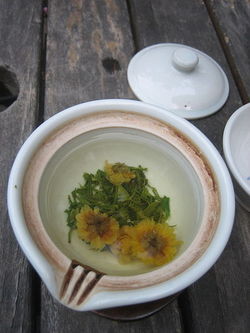
Nomad Tea is part of the Series 7 Sweet, which also features Burnt Sugar, Wood Coffee, Sticky Cake, and Spicy Cocoa. Like practically all of the Comme des Garçons scents since their debut in 1994, it aims to provide aesthetic olfactory pleasure through the sensation of anticipated and realized discovery thanks to an expressly sought-out unusual twist and with oftentimes, but not in this case, a little dose of provocation. The perfume brand owned by designer Rei Kawabuko loves to capture smells of the real world and transcribe them into liquid manifestos that are more or less incisive. Odeur 53 and Odeur 71 are compendia of street, office, home smells, Guerilla 1 only indirectly alludes to a butcher's shop without going to the extent of copying the literal aromas of, say, raw red meat and mutton fat, Red Harissa turns a terracotta red spicy condiment for Couscous into a plausible perfume ingredient, and much more. Nomad Tea is a serene perfume travelogue, like a tea scent can be, making the international roads of tea bifurcate in one imagined place, the scent bottle whimsically shaped like a turban/pumpkin/garlic bulb/fennel, which is meant to represent a sweet. Letting the scent evaporate on your skin is accepting an invitation to drink Moroccan mint tea made with astringent bitter green tea from China sitting at a café terrace in Paris and next, jump to Myanmar on the map to inhale and chew on some fermented Laphet. It is a scent that manages to be both slightly meditative and refreshing, with a calming influence also thanks to the woods, a welcome general psychological state to encourage in ourselves to counteract the summer heat.... Old woman drying tea leaves, Namhsan, Myanmar by Coole Images
Continue reading "•• Comme des Garçons Series 7 Sweet Nomad Tea (2005) •• {Perfume Review} " »
Photo © Etat Libre d'Orange Tom of Finland is the latest fragrance to emerge from the "space of olfactory libertinage" created by Etat Libre d'Orange, a taboo-averse slightly iconoclastic niche perfumery located in Paris. Named after master draughtsman of homosexual eroticism Tom of Finland, whose real name was Touko Laaksonen (1920-1991), the perfume aims to instill the sense that to be "Gay or straight, it doesn't matter. The frontiers have expanded and barriers have faded to make way for a beautiful and original vision of masculinity." It is a joint project undertaken with the Tom of Finland Foundation in Los Angeles which asked as main guideline that it "does not disturb the odor of men," (see previous post)
The problem from the start for founder and artistic director Etienne de Swardt was, if at all possible, to avoid clichéd representations of homosexuality, "With Tom of Finland, the challenge was to avoid a purely sexual banality, a conventional story of propositions clad in leather and conducted in bathrooms. At the Tom of Finland Foundation in Los Angeles, I discovered a world that was highly erotic, but it was an eroticism presented as art, as a veritable religion. Tom's drawings have a fine, elegant beauty; they are never vulgar. They convey a happy sensuality, a light-hearted debauchery. The viewer is amused, entertained. To create the perfume 'Tom', I thought it would be interesting to go to the antithesis of the cliche, and assign the scent to a 'straight' perfumer, Antoine Lie, who has played up the contrast of subject and viewpoint, in his successful interpretation."
Antoine Lie, the perfumer, added, "Although heterosexual, I must admit that many of the most beautiful souls I've met in my life have been masculine and gay. I'm fascinated by their culture, their talent. This perfume is my way of paying homage to them, to show the straight world that there is much to learn from gay society, to blend absolute purity with outright sensuality all the way to a sexuality without borders."
In a way, it can be seen as playing it safe to express these ideas through perfume. How far could it go in provoking sexual walls to fall? Tom of Finland the perfume, like the drawings of the artist, betrays a playful touch, that humor perceptible in the Kake comics characters, never going as far as the more seriously olfactorily provocative Sécrétions Magnifiques. It offers a simplified image of homosexuality, one that anyone can relate to and adopt as scent. It is understandable that the brand would not want to run the risk of putting out a composition that would be felt to be repulsive, like Sécrétions is often thought to be, as this might deliver a negative message about homosexuality and potentially trigger homophobic discourse. Etat Libre d'Orange want to bring you into their fold and so they have devised an appealing perfume that speaks to the cause of gay men, in particular, the ones that recognize themselves in the Tom of Finland archetypes......
 Image © Tom of Finland Foundation
Continue reading "•• Etat Libre d'Orange Tom of Finland (2008) •• {Perfume Review} {Celebrity Fragrance}" »
Sensuous is the latest major feminine launch by Estée Lauder following Tuberose Gardenia Private Collection introduced last year in the summer. If there is an American beauty brand that has consistently aimed to make as many women as possible feel more beautiful through access to fragrance allure and luxury, that would be Estée Lauder. Although it is sometimes stated that Lauder wanted to capture the attention of the upper-classes with her luxuriously feeling scents, their price points indicate otherwise targeting rather the woman who believes she has it in her to live a better life. Private Collection (1973) may have been initially a private gift to Princess Grace of Monaco, but taxi cab drivers loved it just as much and it finally made it to the department store counters. Mrs. Estée Lauder was obviously particularly sensitive to beauty. The models that have graced the advertising pictures of the brand have become the stuff of legend thanks to their gorgeous classical looks.There were Karen Graham, Shaun Casey, Willow Bay, Carolyn Murphy (see Estée Lauder advertisements for more familiar faces). Paulina Porizkova was noted for being a discreet turning point - a sign of the times - a beauty that was slightly less Greek. Liz Hurley further made the Estée Lauder woman archetype feel more accessible. These standards became an iconic reference and even made it into the popular culture. Thus best-selling author Dan Brown tickles the desires of his masculine readership by talking about the main feminine character in his thriller Digital Fortress as looking like an Estée Lauder model, in order to stress her exquisiteness knowing his readers will catch on to that mainstream gold standard of beauty: "Her delicate European features and soft brown eyes reminded him of an ad for Estée Lauder" (p. 16)...... The bottle: the back of the Sensuous bottle is ribbed, adding a sensual tactile element to the experience of the perfume. It is unusual and very pleasant to the touch, almost acting like a worry-perfume-bottle. The jus is a pink-champagne color. Photo © The Scented Salamander.
Continue reading "Estée Lauder Sensuous (2008): A Buttery Fusion of Woods & Amber {Perfume Review} {New Fragrance}" »
Kenzo Power by Kenzo, which rhymes with Kenzo Flower no doubt for harmonizing branding purposes, is destined to be the masculine counterpart to their best-seller feminine scent created by Alberto Morillas in 2000. Like its predecessor, the upcoming Power to be launched in August 2008, takes as source of inspiration the imagined scent of a flower. In the case of Kenzo Flower what served as support for poetic license was a scentless red poppy dear to the heart of designer Kenzo; in the case of Kenzo Power the fictionalized floral reference dissolves further into the vagueness of a non-entity just described as an "imaginary flower". Olivier Polge is the perfumer behind Kenzo Power. He is also the creator of Dior Homme, Guerlain Cuir Beluga, Dior Pure Poison, Victor & Rolf Flowerbomb, among others. Masculines Are Hot
The new Kenzo Power, beyond the in-house reference, appears to be part of new trendy generation of floral compositions for men that were recently reintroduced with some fanfare by Jean Paul Gaultier with Fleur du Mâle (Flower of the Male), a masculine scent centering on orange blossom created by Francis Kurkdjian. If floral notes never really took the exit door of men's fragrances following the prim flowery 19th century filled with gentlemen sporting flowers in their buttonholes and scented with rose at their barber shops, they could be showcased more or less, and as recently experienced, readily flaunted for their modern metrosexual connotations rather than hid as sub-virile. Thus contemporary dandies have pointedly been invited to reconsider their options......
Continue reading "Kenzo Kenzo Power (2008): Trendy Masculinity By Way of Muji {Perfume Review} {Men's Cologne}" »
A Precious Rendition of Musk With its name vascillating like a flame in the direction of Serge Lutens Muscs Koublaï Khan, you might have expected Annick Goutal Musc Nomade to smell like what your imagination of a nomad of yore conjures up, one who faithfully and with great discipline would disregard the distinction between the clean and the unclean as Koublaï Khan once ordered it. If Muscs Koublaï Khan may suggest some of the martial hardiness of the mores in the steppe region of the center of Asia, Annick Goutal Musc Nomade only keeps that other facet found in the first fragrance: an idea of preciousness linked with the utilization of musk experienced as a much sought-after aromatic material purloined from the musk-deer for centuries by nomads who would trade "musk-bags". Musk and its adjective "musky" may point to a certain roughness of style, a naturalness that is borderline offensive especially in North American culture today, but at the same time, it is also the musk of luxury brought back from distant lands with its ascribed aphrodisiac, soothing, beautifying and gustatory properties. The other side of musky as in the French word "musqué" is that it came to mean at one point the reverse of what the ring of the word "nomad" seems to contain, that is an excess of affectation and also coquetry betraying foppishness in 19th century France......

Continue reading "Annick Goutal Musc Nomade (2008): The Inner Orientalist Motif {Perfume Review}" »
Lancôme Peut Etre (2008), which means "maybe" in French (normally written with a hyphen, "peut-être") is a feminine rose and iris composition brushed with fresh and green spring-like notes on top while offering at the same time a warm ambery-musky counterpoint in the base. The latter consists in a sumptuous, endless incense-y and resinous dry-down. The perfume offers thus two distinct atmospheres.Connoisseurs of old-school perfumes with lasting yet elegant sillages should be delighted. According to the Financial Times, "La Collection brings together original masterpieces whose compositions reveal surprising complexities," says Liz Mearing of Lancôme. "These fragrances also capture a recent trend for beautiful, vintage scents that are created to the highest standards. It's very exciting to be able to offer something so special to a discerning, niche audience." Lancôme initially launched Peut-Etre in 1937 and it is ascribed to Armand Petitjean who was not a perfumer but the founder of the brand. He is also known as a former managing-director and apprentice of François Coty, the father of modern commercial perfumery. This spring Lancôme reintroduced a reorchestration of the original scent in La Collection series of "haute parfumerie classics". The original perfume was reportedly updated and recreated by perfumer Nathalie Lorson. It is classified by the brand as a musky floral, which is a bit of an over- simplification for a scent that presents other meaningful facets. I experienced an authentic shock of discovery after having described the perfume and written about some of the images it suggested to me as then I happened on a 1940 advert for Peut-Etre by E.M. Pérot where the iconography seemed to mirror my description of the new scent (see after the jump). This seems to indicate that Nathalie Lorson worked closely with the original formula as the imagery found in the 1940 advert is not hinted at in any way by the new press release (no incense is mentioned, for example). It suddenly felt like a slightly disturbing oniric and pythian incursion into the realm of archetypes. If you look at the first advert below (also seen after testing the scent in fact), you can see a reiteration of the fundamental theme I describe in the review and which comes through much more clearly and precisely in the second 1940 advert. These advertising images therefore do seem to speak about the perfume and about its main thrust as well as important secondary facets. Due to this "revelation" my review is layered, one more unaware and the other more informed, post-epiphany.....
Continue reading "Lancôme Peut-Être (1937-2008) {Perfume Review} {New Fragrance}" »
Un Jardin Après La Mousson is the latest and third fragrance installment in the Jardin series proposed by Hermès and created by in-house perfumer Jean Claude Ellena. Following Un Jardin en Méditerrannée and Un Jardin sur le Nil, Un Jardin Après La Mousson (A Garden After The Monsoon) aims to capture the spirit of a place and lift a stone of the vegetable world that was left unturned. Hence the concerted effort, like that of some painters' - Gauguin comes to mind but perhaps even closer to Ellena's world, Cézanne - to travel or go to the mountain (Mont Victoire), and observe the world in a different light.
Like its scent predecessors, Un Jardin Après La Mousson is based both on original empirical impressions garnered in situ by displacing the nose to a more or less distant locale and, if we are to believe Ellena, in the end, discarded in order to make room for the perfumer's own free movement of interpretation. He recently said that he does not care about reality.
Despite this pronouncement, to be clarified, usually what Ellena retains from his peregrinations is a novel, out of the ordinary smell that will anchor his composition. For Bois Farine by L'Artisan Parfumeur it was a a tree in the Reunion, a species whose red flowers diffuse a flour-like aroma. The fragrances in the Garden Series all showcase a fleshy fruit (fig/prune, mango, cantaloupe/watermelon) that gives way to a transparent, watery impression. With the latest Un Jardin Après La Mousson, the least easy and most complex of the garden scents, one encounters a delightful realignment of well-known ideas and sensations that gives in the end an unexpected and very original fragrance. The variegated nature of the scent, yet its harmonious tonality makes you think of a kaleidoscope reshuffling white, transparent, green, and blue crystals -- the colors of Impression, Soleil Levant. The felt plurality of the sources of its inspiration conjures up the vision of a page from the Moleskine notebook Ellena uses and in which different ideas are noted down and worked upon. The result is very idiosyncratic and full of perfumery quotes. The scent is in a Hermès bottle but could easily be poured into a Comme des Garçons one instead and touted as avant-gardiste. Ellena has made apparently contradictory statements about his more or less essential need for nourishment coming from the real world. There is for him a need for an olfactory trigger of inspiration on the one hand - the aromas of teas at Mariage Frères (Eau Parfumée au Thé Vert), the natural licorice-y facet of turmeric (he could have used it for Brin de Réglisse had he encountered it sooner), the smell of a grove of green mangoes in Egypt or fig leaves on a tray at a cocktail party in a Mediterranean garden - and his professed absolute disregard for slavish olfactory copies of the empirical world on the other hand. Impression Soleil Levant, the painting that gave its name to Impressionism
One way to understand the seeming fundamental tension that Jean Claude Ellena seems to point to in his relationship to the natural world - both seeking it out and rejecting it - is to liken his approach to that of Marxists..... just kidding......the Impressionist school of painting. Like these painters who were mobile painters, the perfumer feels an urge to come in direct contact with the objects he will paint, look for them in open places, dig them out perhaps more so since olfactory objects can be unseen and are less well known and cataloged - try knocking on the door of the local tourism agency and asking them what is there to smell in the region? - and in the end filter them through his own impressions. The watercolor-like texture of his Jardin perfumes invites this comparison further, making you think of the lilies on a pond series of Claude Monet and suddenly making you realize also that the vegetal motif on the packaging of Un Jardin sur le Nil is not unlike them. Monet was after all dubbed a poet of gardens and water. Next a composition centered around the garden of Giverny would seem appropriate and natural. However according to Le Nouvel Observateur, Un Jardin Après La Mousson "brings the water trilogy to a close.".......
Continue reading "Hermès Un Jardin Après La Mousson (2008): A Strange, Original Tapestry of Familiar Accords {Perfume Review}" »
The latest Dior Escale à Portofino (Port of Call in Portofino) created by François Demachy presents itself as an unconventional, rethought Eau de Cologne. It clearly borrows its main structural idea from the genre which first came to be known to the public in the 18th century under the name Aqua Mirabilis, but lets through a rethinking of the concept influenced by the existing Cologne Blanche by Dior, a previous niche cologne offering from the house created by Francis Kurkdjian which pairs fresh and soft. Escale à Portofino can further be seen to develop the in-house lineage of freshness in perfumed compositions inaugurated by Edmond Roudnitska at Dior but pulling it in the direciton of the spare "niche" feel of the trio of colognes by Kurkdjian. The scent is part of a new line of summer fragrances illustrating a travel theme, a mirror collection of perfumes to the annual Dior Cruise Collection designed by John Galliano. Freshness, but also Transparency and Softness Roudnitska the Elder, if we may so call him, (his son Michel Roudnitska is also a well-known contemporary perfumer) is famous for having brought to life fragrances playing upon sensations of lightness and clarity such as Eau d'Hermès (1951), Eau Fraîche (1953), Diorissimo (1956), Eau Sauvage (1966), and Diorella (1972) when full-bodied perfumes for women were a dominant norm. Like Poiret encouraging women to drop the corset and traditional focus on waist and hips, Roudnistka seems to have followed a comparable intuition with his non Femme-like fresh perfumes asking women to lighten the structural ornateness of their scents and make it more modern, different, perhaps more fluid...... Panorama of Portofino by Giorgiopix
Continue reading "Dior Escale à Portofino (2008) {Perfume Review}" »
Mariah Carey launched her debut signature perfume, M, last year and since then there has been only positive buzz about it as far as we can tell. Celebrity perfumes are always suspected of being crass vehicles for loud branding and sheer money-making, except by their fans, and magic in a celeb's bottle is not expected by most people. M seems to be a case where the famous personality was able to have her say and impact the making of the perfume significantly while the perfumers seem to have intuited her well. Maybe we will learn one day Carey wanted it to smell like a billy-goat and the marketers set their foot down, but the perfume seems to go well with her perceived image on yet another level of synergy, that of the celebrity's image and her or his fragrance. What can catch one's attention at first is the fact that M sounds authentic because it presents blatant idiosyncratic traits: a marshmallow note with a sea breeze accord and then some Moroccan incense? Quid? It sounded like the notes were there for a reason because they sounded rather whimsical thrown into the same mix. We also later thought that it might be a little in the line of Dune by Dior (marine incense) and so were doubly curious as this one is a rather unusual scent below its surface of mainstream respectability........
Continue reading "Mariah Carey M (2007): From Smells to Floriental {Perfume Review}" »
Fragrance Review of Balmain Ambergris
The Smell of Natural Gray Amber or Ambergris {Scented Thoughts}
Ambergris is an organic animalic material excreted by sperm whales (Physeter macrocephalus). This substance in its natural state or near-natural state, i.e., as an infusion, on which I am basing my olfactory report here, has a wonderful, deep, and almost unbearable intensity before it finally mellows down. The tiniest amount of what is already a dilution, something like 5 % in alcohol, takes on a life of its own once it hits the skin becoming worthy of the most ostentatious of monarchs holding court with a seductive, yet iron fist.
Before it alights on the skin, the scent of ambergris emanating from a phial evokes intriguingly enough the smell of pungent dusty old leather-bound books, ones that would have been left to gather the aromas of spices in the most stocked-up of the Comptoir de la Compagnie des Indes spice warehouse and the most religiously frequented too as a suggestion of smoky incense passes before the nose.
Once transfigured by the warmth of the skin, the ambergris starts to glow and finally becomes that sensation to which it gives its name, amber-y, creating a luminous effect which is very close to the visual sensation felt next to a fire burning in a fireplace or sunlight shining through a thick brown glass bottle.
A thousand nuances seem to congregate into a few recognizable facets smelling of dry herbs but also of peach, apricot, leather, dusty parchment, baby powder before the fact, white rice flour, a tinge of almond, sweet fruits, earth, skin, sandalwood, wine-y resin, manure, sand, iodine, hay, moss, cinnamon...It is a world opening up in and of itself, a minuscule universe that has formed thanks to the sea, salt, sun, and marine animals...... "Raisins" amber glass bracelet by René Lalique, 1919, from Ragoarts
Continue reading "Balmain Ambre Gris (2008) {Perfume Review} {New Fragrance} {Scented Thoughts}" »
Sycomore is the latest composition by perfumers Jacques Polge and Christopher Sheldrake appearing in the collection Les Exclusifs by Chanel, which purports to offer more elaborate works of perfumery utilizing finer ingredients and proposing more delicate art-pieces for the connoisseur.
The fragrance is also a new take on an old idea for the house of Chanel, which remains tradition-bound in order to preserve the spirit of Mademoiselle Chanel since an initial Sycomore perfume was launched in 1930 that aimed to be seemingly this contradictory object: an uncluttered woody perfume for women supporting an overall baroque interpretation. In Michael Edwards, Perfume Legends, Jacques Polge is reported to have characterized both Bois des Iles (1924) and Sycomore (1930) as baroque pieces. The old perfume Sycomore then very interestingly already provided inspiration to him for the creation of Coco as one of two perfect fragrance embodiments of what he saw to be the lost style of Coco Chanel, now seen predominantly through the prism of her clothes. That lost side of Chanel was her less-well known predilection for the complicated chinoiseries and opulence of gold-leaf work as revealed by her Rue Cambon apartment to the in-house perfumer who explained that he wanted to absorb her influence by mediating in-situ about her taste. Admittedly though, Chanel's taste for baroque opulence and excess is more clearly apparent in her accessories, jewelry in particular.
It is therefore also the second attempt at least on the part of Polge to recapture some of the soul of the original Sycomore, but it seems going in a new interpretive direction, more towards the idea of showcasing pure woods, although a baroque hint is present as well.
More recently, Jacques Polge is reported to have wanted to concentrate solely on vetiver (Vetiveria Zizanoïde) and its natural facets this time. Despite the reported express intention not to see the vetiver be overtaken by other facets (see previous post), it seems that the incense-y facet in Sycomore is almost as equally important as the vetiver one, an already smoky varietal here.
Sycomore is a beautiful, even stunning wood and incense composition that manages to awaken the combined evocative powers of vetiver and whirling incense, their decidedly exotic association in this case, while offering itself at the same time as an oh!-so-French study in ideals of understated refinement and elegance. A little baroque flourish is discreetly inserted in the signature of the perfume as an homage paid to the spirit of the Grande Mademoiselle, she who instinctively knew how to embrace the contrasted purity of monastic lines and the golds of aristocratic ostentation and excesses to feel complete. You are tempted also to recognize the influence of perfumer Christopher Sheldrake in this discreet exotic touch.
The perfume conveys its, if you will, French style or Chanel world-view through its intuition for pure lines - like a French window, a French garden - in its sense of refined, controlled, balanced and clear, Cartesian elegance. At the same time there is to be found a sense of Baudelairean voyage to the perfume, but without that hint of opiate-laden, heavy voluptuousness found in the weight of velvet curtains or sensual women's manes as populate that universe. Something airy and pure traverses Sycomore, suggesting the original spiritual, meditative qualities of burning incense and smoke (smoky woods) while alluding to a quiet, reserved and polite sense of mysticism......
Continue reading "Chanel Sycomore (2008) {Perfume Review} {New Fragrance}" »
|
Fin O'Suilleabhain on
Les Exclusifs: Bel Respiro, No 18, & 28 La Pausa by Chanel {Perfume Review & Musings} {New Perfumes}
: Hi ... can I ask about the Stravinsky / Chanel image. Is ...
Thalestris Dupont on
Fragonard Caresse (1929/2008) {Perfume Review}
: Lovely perfume! Reminds me of the spring 2011 when I was wearing ...
Karen Lindsey on
Long Lost Crabtree & Evelyn Fragrance: Help Please {Ask The Readers}
: I just found this site and I so need to find someone ...
Regina on
Happy New Year 2012!
: Valentine's Day will soon be here. Any recommendations?
C Sasich on
Easy Tricks To Create Golden Globes Hairstyles! {Beauty Notes - Hair}
: My fave was Michelle Williams - modern , effortless not overdone . ...
kelvin neo on
Victoria's Secret Life is Pink Wish Pink, Live Pink, Hope Pink (2010) *New Fragrances*
: Hi good day, Can i know where can purchase or order Pink ...
Alan on
A Funny Post About Scented Candles {Fragrant Reading}
: Hell-scent candle, lol.
Gina on
Two Organic Oud Scents: Sama Oudh Jasmin & Undergreen Black Classic (2011) {New Perfumes}
: I want to try Sama Oudh Jasmin but checked the websites. I ...
Tammy on
Top 12 Best New Department Store Fragrances of 2011 for the Holidays {Perfume List}
: Wish this came with a little print out sheet for my next ...
Toñi on
Dance with Givenchy (2010) {New Perfume}
: Where can I get Dance with Givenchy? It's impossible to find it ...
Toñi on
Dance with Givenchy (2010) {New Perfume}
: Where can I get Dance with Givenchy? It's impossible to find it ...
evageli karounzou on
Choppy Waters for Stella Cadente Miss Me {Fragrance News}
: at 2007 i was in paris an i bought this perfume.Since then ...
Mandy Aftel on
Aftelier Perfumes Secret Garden (2011): Featuring Real Civet & Castoreum {New Fragrance}
: Thank you so much Marie-Helene for your lovely review! You are great ...
Kay on
Mona di Orio Chamarré (2009): Perfume Review in Memoriam
: This is very interesting. First thing that came to my mind when ...
Maddy on
Bint el Sudan, The Other, African Chanel No.5: Interview with Nick Evans of International Flavors & Fragrances, Inc. {Perfume Q & A - The Scents of Africa}
: Interesting post. I've lived in Ghana but I don't remember encountering anyone ...
All original content and translations herein copyright © 2006. All rights reserved; reproduction requires the author’s prior written consent. You are however welcome to provide a link back to the posts on this site as long as you explicitly mention their authorship, recognize the original source of the information you give, and acknowledge the site of origin.
Powered by Movable Type 4.32-en
|