|
|
Sycomore is the latest composition by perfumers Jacques Polge and Christopher Sheldrake appearing in the collection Les Exclusifs by Chanel, which purports to offer more elaborate works of perfumery utilizing finer ingredients and proposing more delicate art pieces for the connoisseur. It is a new take on an old idea for the house of Chanel since an initial Sycomore perfume was launched in 1930 that aimed to be seemingly this impossible thing: an uncluttered wood perfume for women ending up being a baroque composition as well. In Michael Edwards, Perfume Legends, Jacques Polge is reported to have characterized both Bois des Iles (1924) and Sycomore (1930) as baroque pieces. Sycomore then very interestingly already provided inspiration to him for the creation of Coco as one of the two perfect fragrance embodiments of what he saw to be the lost style of Coco Chanel, seen predominantly through the prism of her clothes. That lost side of Chanel was her equal predilection for the complicated chinoiseries and opulence of gold-leaf work as revealed by her Rue Cambon apartment to the in-house perfumer. It is therefore also the second attempt at least on the part of Polge to recapture some of the soul of the original Sycomore, but it seems going in a new interpretive direction, more towards the idea of showcasing pure woods although a baroque hint is present.
More recently, Jacques Polge is reported to have wanted to concentrate solely on vetiver and its natural facets (Vetiveria Zizanoïde) this time. Despite the reported express intention not to see the vetiver be overtaken by other facets (see previous post), it seems that the incense-y facet in Sycomore is almost as equally important as the vetiver one, a smoky varietal here.
Sycomore is a beautiful, even stunning wood and incense composition that manages both to awaken the combined evocative powers of vetiver and incense, their decidedly exotic associations in this case, while offering itself at the same time as an oh!-so-French study in ideals of understated refinement and elegance. A little baroque flourish is discreetly inserted in the signature of the perfume as an homage paid to the spirit of the Grande Mademoiselle, she who instinctively knew how to embrace the contrasted purity of monastic lines and the golds of aristocratic ostentation and excesses to feel complete. You are tempted also to recognize the influence of perfumer Christopher Sheldrake in its discreet exotic touch.
The perfume conveys its, if you will, French style or Chanel world-view through its intuition for pure lines - like a French window, a French garden - in its sense of refined, controlled, balanced and clear, Cartesian elegance. At the same time there is to be found a sense of Baudelairean voyage to the perfume, but without that hint of opiate-laden, heavy voluptuousness found in the weight of velvet curtains or sensual women's manes as often populate that universe. Something airy and pure traverses Sycomore, suggesting the original spiritual, meditative qualities of incense and smoke (smoky woods) while alluding to a quiet and polite sense of mysticism......
Continue reading "Chanel Sycomore (2008) {Perfume Review} {New Fragrance}" »
Here are some suggestions for wearing spring fragrances, in several installments. Today, we turn to the "effortlessly chic" category. By that we mean that as lighter, fresher perfumes these fragrances tend to dress down a bit, but not overly so. They retain an air of elegance and sophistication about them mixed with a dose of studied nonchalance and casualness. Why should some perfumes be considered to be particularly appropriate for spring time? Their vernal quality is suggested by their rich yet still frail floral notes, their freshness, and their luminosity speaking of the spring equinoxe and daylight saving time. Green notes that are just a bit crunchy also contribute to this feeling of smelling half-open buds. These scents offer transparent, airy, cool nuances rather than ripe, decaying ones. When brainstorming about the topic, we had to realize that the house of Guerlain had been particularly committed about offering interpretations of spring perfumes. Nina Ricci too although only one of their scents is mentioned.
This is just a snapshot of a state of desire and daydreaming filled with memories about spring and evocations of some classic perfumes that might represent it best or accompany it best.
1- Diorissimo No list about classic perfumes embodying the yearning for spring would be complete without Diorissimo by Dior. Composed by master-perfumer Edmond Roudnitska in 1956 it remains a central reference as the lily-of-the-valley fragrance that has come to embody the very spirit of spring for generations of wearers. It is like drinking muguet-scented champagne on the pristine empty streets of a clean Paris in the wee hours of the morning listening to a party laughter that never ends. You own the city of lights and you own spring. It too could have been called Joy......
Continue reading "11 Effortlessly Chic Spring Fragrances: The Classics " »
Photo © Communication Serge Lutens Serge Lutens possesses this uncanny ability of turning a priori the most superficial, surface objects and sensations into an oniric walk taken down the maze of a garden as if in a daydream. With Five O’ Clock Au Gingembre composed in collaboration with perfumer Christopher Sheldrake, a tea party in an English manor opens the way to the muffled, velvety footsteps of a discovery walk down the dozens of labyrinthine corridors of a mansion built with hundreds of forgotten rooms. At the same time the contained intensity of the perfume, which unfurls as if following the line of a fall suggests a drop in a well filled with dark light. The perfume is thus complex in the sense of creating both a horizontal line of imagery, by minutely shifting the sensations, and a vertical one by creating an impression of dynamic deepening. Five O'Clock is one of the most difficult perfumes I have had to write about due to the level of detail found in it and its structuring which is poorly rendered by a chronological account. I am tempted to say that it is more constructed like a faceted gem, but it is not quite that either. It is more like a combination of both structures, the linear one and the prismatic one. Or another way to put it would be to say that it is the most elusive of the Lutens despite its deceptive homey title...
Photo © Communication Serge Lutens
Continue reading "Serge Lutens Five O'Clock Au Gingembre (2008): The Black Luminous Intensity of Ginger {Perfume Review} {New Fragrance}" »
Photography by Serge Lutens, reproduced with the permission of Peter Gabor - © Reproduction is forbidden, used for pedagogical purposes. As people will see in the second part of our interview with Serge Lutens (see Part 1), he is a mind that always thinks beyond the predictable limits set by a question. Here he expresses himself regarding Baudelaire's legacy, his line of makeup, the mythical Nombre Noir fragrance, niche perfumery, and his contribution to contemporary perfumery. Marie-Helene Wagner: 16 – Do you think that speaking of perfumery, we are the heirs to Baudelaire? Serge Lutens: - Perfume, in and of itself, is not just an aroma. It is potentially a carrier for the imagination. Perfume is thick; it is poison and pure desire. It is Eros in prison! I think that we are first and foremost the heirs to frustration, but also to revolt, with means that the ones who have not subjected themselves still have aspirations…. "Coiffe façon Tatlin Tower" by Serge Lutens, an interpretation of the unfinished Tatlin Tower built by architect Vladimir Tatlin.
Continue reading "Q & A With Serge Lutens - Part 2 {Perfume Q & A}" »
Some people remark that wine enjoys a status unparalleled by perfume despite the wide acceptance of the latter as an object of luxury. What is missing? First there is the suspicion that all that is contained in a bottle of perfume is not equally valuable: rare materials mixed with cheaper ones to offset the costs of producing a fragrance; the small percentage of “jus” that actually makes up the perfume, the rest being a much more common carrier. Finally and most importantly, it may be that what is touched by the hand of man, a little too much, deprives perfume of the natural nobility ascribed to the rich, unpredictable, and finally tamed products of the earth in traditional agricultural societies.......
Continue reading "Fleur d'Oranger 2007 by L'Artisan Parfumeur: On Agricultural Values in Perfumery {Perfume Short (Review)} {Scented Thoughts} {New Fragrance}" »
The perfumes issued by Jovoy the newly re-established house founded by Blanche Arvoy in 1923 and now revived by François Henin, Henri de Pierrefeu, and Marie-Laure de Rodellec (see also post on the "patrimony movement" in French perfumery) pose the interesting question, to us, of the significance of the name and concept behind a perfume in their influence over the composition of the fragrance and the communication of its personality to the wearer. If a perfume is art, then it is about the attempt to establish a bridge of communication between two imaginations, two universes, those of the creator(s) and the wearer(s). Perfumes named with non-particular names, but rather with names denoting the whole group or family of perfumes might well be in danger of blunting precise images, precise sensations. It is very difficult to assess how much a name influences our perception of a perfume without doing psychological tests about olfactory creation and perception and expectations. Perfumes might very well be inevitably linked to stories and names as the other halves of themselves, which includes the shape of the bottle, another story told with different materials........ 
Continue reading "Chypre, Oriental, Poudré by Jovoy & Chypre by Coty: On Perfume Names {Perfume Shorts (Reviews)} {Scented Thoughts} {New Perfumes}" »
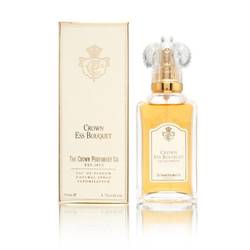
ESS Bouquet by The Crown Perfumery Co., as one of the oldest English fragrances to exist, is one of those perfumes steeped in history and antique exotic tastes that require further investigation and elucidation to fully appreciate. First we have to address the meaning of its name, which sounds a bit puzzling to the modern ear: “Ess Bouquet” we learn from Septimus Piesse writing in 1857 is but the contraction of the word “essence of bouquet”. The original recipe for the scent, by an anonymous London perfumer, is recorded as early as 1711 and by the time Piesse writes his The Art of Perfumery in the mid-19th century this original date has been forgotten and the much imitated perfume formula is attributed to, not its rightful creators whoever these may be, but rather to its famous developers, Bayley and Co., established 1739. Septimus Piesse thus mistakenly attributes the paternity of Ess Bouquet to its most celebrated makers at the time,
“The reputation of this perfume has given rise to numerous imitations of the original article, more particularly on the continent. In many of the shops in Germany and in France will be seen bottles labelled in close imitation of those sent out by Bayley and Co., Cockspur Street, London, who are, in truth, the original makers.”.......
Continue reading "Ess Bouquet by The Crown Perfumery Co. {Perfume Review & Musings}" »
Covet promised to reveal more freely the “vixen" side of Sarah Jessica Parker and since we know that Lovely (2005) had a toned-down musk that smacked of marketing compromise for the actress who usually loves her musk straight-up and dirty, we were expectant and holding our breath metaphorically speaking, awaiting something like a modern-day Bal à Versailles, a gift from the fragrance developers to SJP after her resounding success with Lovely in 2006. Instead what we get is yet another perfume in shackles and Covet is not even as pretty smelling as Lovely, which does not make it necessarily more interesting smelling.......
Continue reading "Covet by Sarah Jessica Parker {Perfume Short (Review)} {New Perfume} {Celebrity Fragrance}" »
Jacomo For Her by Jacomo is one of those fragrances that we like to call “closet-musk fragrances”(see Floris Malmaison), whose definite musky nature and erotic power lie further hidden within the folds of the perfume. They are not advertised officially as musk fragrances, but they possess the simplicity of purpose of their less subtle sisters who bear the title of a day or evening program of erotic approach on their packages. “Musk” is written in bold lettering on the box to help guide the shopping hand; it would flash and twinkle if it could. “Buy me, I will make you more desirable…” are the words whispered by practically every perfumes on earth, but musk fragrances, even more so than others, are born to seduce......
Continue reading "Jacomo For Her by Jacomo {Perfume Review & Musings}" »
Like the laying out of the 12 first steps of an Inca pyramid made of black onyx, we now have been offered the 12 building blocks of the Tom Ford fragrance house. The 12 scents of the new line are called Amber Absolute, Noir de Noir, Velvet Gardenia, Black Violet, Tobacco Vanille, Oud Wood, Purple Patchouli, Bois Rouge, Moss Breches, Tuscan Leather, Neroli Portofino and Japan Noir. The scents are described as perfumes constructed around a main note folded into secondary notes. In this manner and despite the richness of their textures the perfumes are not particularly complex. They offer dense, heavily textured sensations most of the time, but not necessarily deep and multi-layered in the longer term. The notes themselves have a certain depth - they are fleshy, often opulent -but the structures of the perfumes are rather straightforward. Often one gets an opening stage as discrete as the blasting of a police siren on an empty Sunday morning street followed by some relinquishing, a renewed, often invasive presence, and then a clean-shaved impression of a drydown.
A line of continuity with Black Orchid is apparent as the concept of a sub-genre of dark tropical juices with slightly nefarious accents endures, meanders into new territories and draws a geographical map of Tom Ford's desires and obsessions. "It's rare that I like a very light floral," he says. "I'm rarely drawn to roses, for example. I'm more a tuberose, gardenia, jasmine, sort of deeper, sort of heady ... heady ... heady...."..........
Continue reading "Tom Ford Private Blend: An Overview {Perfume Review & Musings} {New Perfumes}" »
As previously reported, the upcoming perfume launch by Calvin Klein has adopted the rapid text messaging style of the new digital generation to define its image and is called CK in2u. According to the press release, "ck one is about connecting with the group, ck be is about connecting with yourself, and ck IN2U is all about connecting with another person." Even before the perfumes have been made available to the public (but you will read a review of them first here), the advertising campaign around the duo of fragrances for her and for him is generating quite a stir in the media and in particular in the blogosphere where acerbic remarks seem to resound like shouts emanating from angry young people, precisely the ones targeted by the advertisers, i.e., the millenials or people born between 1982 and 1995......
Continue reading "CK IN2U for Her & CK IN2U for Him by Calvin Klein {Perfume Review & Musings} {New Perfumes}" »
La Fuite des Heures, also marketed under the English name Fleeting Moment, was created in 1949 by the great perfumer Germaine Cellier who also gave us Coeur-Joie by Nina Ricci, Bandit by Piguet, Elysées 64-83, Jolie Madame,Vent Vert, and Monsieur Balmain by Balmain, amongst others. Her style can be characterized as bold, forceful (Bandit, Vent Vert) yet also capable of creating infinitesimally subtle nuances (Coeur-Joie). Today, one can find traces of her more forceful, almost primitive style at times in Mona di Orio's work, while her originality can be found again in Olivia Giacobetti's creations. La Fuite des Heures contains both her primitivist and softer romantic sense of nuances. Like the picture La Danse (The Dance) by Fauvist André Derain who was a friend of Germaine Cellier and for whom she posed, it is an ensemble of bold and graceful lines and as it turns out, seems to be colored with the same color tones: the brown of the amber, the grey of ambergris, the dark brown of leather, the chartreuse green of the anise, the darker green of thyme, the yellow of the hay, the mauve of the violet or orris, the golden hues (for me) of jasmine......
Continue reading "La Fuite Des Heures by Cristobal Balenciaga {Perfume Review & Musings}" »
L'Antimatière is one of the three scents from a triptyque of perfumes created by nose Isabelle Doyen for a new perfume brand called Les Nez: Parfums d'Auteurs (The Noses: Authors' Perfumes), which was established in the fall of 2006. Isabelle Doyen is also the in-house perfumer for the house of Annick Goutal where she created perfumes noted for their beauty and originality sometimes but not for their avant-garde or l'art-pour-l'art characteristics. Les Nez reveals her more modernistic, daring, and experimental side. Stefan Zweig and Jorge Luis Borges, I have been told by the founder of Les Nez, were the literary supports of their brainstorming sessions for the perfumery project.
The person behind the concept of the new label is René Schifferlé, a businessman and fragrance collector from Switzerland with a demanding sense of the creative possibilities offered by today's perfumery, who decided one day that the vaccuum he perceived to exist needed to be filled with certain perfumes of the future that were, he felt, simply "lacking" from the market.....
Continue reading "L'Antimatière by Les Nez {Perfume Review & Musings}" »
Rousse (russet, ginger, red-headed) is the silken and frothy-sounding name in French given to the upcoming spring 2007 perfume launch by designer Serge Lutens. It will be available from February in the export line. Like the rest of the collection, it is the result of an on-going collaboration between Serge Lutens and nose Christopher Sheldrake. It is said to be inspired by the finale of French pop singer Mylène Farmer's show "Avant que l'ombre" and the russet-colored couture dress she wore on that occasion made for her by Franck Sorbier.
Rousse contains notes of mandarine, cinnamon, carnation, cedar, sandalwood, violet, vanilline, amber, balsamic notes and more since it develops a Tiger Balm accord (like the recent Heeley Spirit of the Tiger)....
Continue reading "Rousse by Serge Lutens {Perfume Review & Musings} {New Perfume}" »
M.A. Sillage de La Reine is a project of historical reconstruction of one of the most fragile cultural artifacts to exist, perfume. The project takes place in the context of the recent restoration and opening of Marie Antoinette's domain at Château de Versailles in July 2006 and the new interest - and shall we say adulation for her in France - that has come to replace the collective feelings of distrust by the French that led her to the guillotine in 1793. As Mona Ozouf has pointed out it seems that what is taking place today is the opening of a beatification process for the former French queen and Austrian princess. The recent publication of a critical edition of Marie Antoinette's correspondence by Evelyne Lever has led a critic from Lire to conclude that despite the new evidence that is now presented "One will never know who Marie Antoinette really was and this is all to the advantage of her legend."Indeed M.A. Sillage de la Reine follows that logic by seeming to shed light on Marie Antoinette's tastes and personality only to reinforce the myth. The re-creator of the perfume, Francis Kurkdjian, explained himself that the queen could not have been expected to wear just one scent nor wear exactly the same one over time as fragrances were unstable due to the naturalness of the ingredients....
Continue reading "M.A. Sillage de la Reine by Château de Versailles {Perfume Review & Musings}" »
This is part I of my review of Perfume: The Story of a Murderer. I will devote a second part to the perfumista's point of view when watching the movie. In this first part, I offer a more general analysis of the movie. The movie Perfume: The Story of a Murderer is both a hyper-realistic and flamboyant adaptation of the novel by Patrick Süskind initially published in 1985, a story that for a long time was famously deemed impossible to adapt by the likes of Francis Ford Coppola and Martin Scorcese. After years of tribulations, German producer Bernd Eichinger ( In the Name of The Rose) succeeded in securing the rights from reclusive author Süskind, apparently convincing him that his own vision would be up to the challenge. It is reported that the German writer would have ideally liked to see Stanley Kubrick do the adaptation. Director Tom Tykwer ( Run Lola Run, a must-see) who was brought in later then had to overcome two main obstacles. First a classic one, the challenge of adapting a suspenseful thriller that had been translated in this case in 45 languages and read by millions worldwide. The second one, more daunting, more original, more creative, and more historic, that of adapting an "olfactory novel" on-screen....
Continue reading "Movie Review of Perfume: The Story of a Murderer (2006) by Tom Tykwer, Part I {Perfume/Film Review & Musings}" »
 From Lithuania comes a new eponymous fragrance by designer Juozas Statkevicius, an eau de parfum a priori exotic, mysterious, and as it turns out deeply contemplative and sensual. This perfume so moved me that it made me experience for the first time as provoked by a perfume and in spite of myself a knot of emotion in my throat. I do not understand the effect of the fragrance completely but I will attempt to describe it. But first some context. Juozas Statkevicius is known as a provocative and innovative designer from Vilnius, Lithuania. He made his fashion debut in Paris in 2002 with a collection of unconventional designs which brought him overnight recognition. There was his shawl with a pillow sewn in it. A model wore arm bracelets representing human bones in black and silver. All on the catwalk wore makeup that included some drops of fake blood dripping on their faces....
Continue reading "Juozas Statkevicius/Josef Statkus Eau de Parfum {Perfume Review & Musings}" »
Black Orchid, as its name promised to deliver, is a dark voluptuous perfume with all the attributes necessary to become the scent of choice of a film noir femme fatale. The perfume seems to play, from the onset, with the evocation of disquieting shadows projected on the wall of a passion crime scene and makes us enter a universe replete with seething sensuality, foreboding and mystery. It is a beautiful rare, both dark and unexpectedly green, heavy and fresh perfume with gourmand and even slightly offensive overtones. Remarkably so, the scent toys with some near-repulsive olfactory facets such as the smells of cheese and borderline decaying matter found in certain tropical flowers due to the combined presence of compounds like dimethyl disulfide (DMDS, 1) and dimethyl trisulfide (DMTS, 2). The perfume artfully manages to stay precisely on the edge of repulsion, suggesting it more as the next possible order of things rather than making it concretely be felt....
Continue reading "Black Orchid by Tom Ford {Perfume Review & Musings}" »
Eau d'Italie Le Sirenuse Positano is a line of perfumes originally inspired by Hotel Le Sirenuse in the locale of Positano on the Italian Amalfian Coast. To the initial Eau d'Italie have succeeded three other perfumes, all inspired by Italy and its history: Paestum Rose, Sienne L'Hiver (Sienna in Winter), and Bois D'Ombrie (Umbria Woods). I find that perfume and nostalgia being intimately linked, it is only fitting that a sense of place be translated into perfumes. The symbolic gesture of taking a handful of dirt and inhaling its scent deeply to be reminded of one's roots and provenance is something that all people who have been transplanted in their lives can relate to. It may be those few grams of earth, that some even take with them upon leaving, as it may be any types of physical evidences of our lives past. I also said earlier that nationalism as a deeply aesthetic emotion could be potentially shared and reactivated through the sharing of common, iconic smells. Le Sirenuse seems thus to be piecing together an image of Italy, ideal and worth remembering. It is a romanticized version of the Italian peninsula in the fall and winter...
Continue reading "Paestum Rose, Sienne L'Hiver, Bois D'Ombrie by Eau D'Italie Le Sirenuse Positano" »
Balahé by Léonard was created by nose Daniel Molière during the attention-craving, power-hungry 1980s showcasing, fashionwise, the big threes: Big hair, Big shoulderpads, and Big sillage. Dynasty was shown everywhere in the world and more importantly watched everywhere. Today, or at least until recently, SUVs were the new Big seeing the transformation of women dressed in armor-like dresses and helmet hairdoes into creatures more casually dressed but well protected by the shield-like accessory that the SUV came to be.
The flacon of Balahé retains some of the elemental forces at play in our lives in its design. The black glass bottle designed by Serge Mansau is like a shape half-bottle, half-rock calling us back to yet a further point in the past, probing our unconscious memories of cave dwellings and fights for survival. It is speaking, hissing to our reptilian brain. Has the story changed much? Apparently not. The global success of Angel by Thierry Mugler is a constant reminder that an important part of perfume-wearing has still to do with the art of war and impress/fear tactics. Many women wearing Angel claim that they feel protected by it. Psychologists speculate that strong perfumes might help cover up insecurities and create a strong persona where vulnerabilities lie. You are saying in other words "don't mess with me" more or less politely, with your perfume, thus expressing, thanks to the symbolism of aromas, your inner agressivity that is successfully projected outwards without having to put it in so many words. Perfume critics often use the term "projection" to speak of a perfume and to define its aromatic impact on the immediate environment...
Continue reading "Balahé by Léonard {Scented Thoughts & Perfume Review & Musings}" »
The Night Porter (1973/74) was a very controversial movie at the time of its introduction and remains to this day. It is the story of the destructive and sado-masochistic relationship uniting a concentration camp survivor and her former Nazi torturer. The movie was based in part on interviews done by Liliana Cavani with concentration camp survivors.
As the characters, played superbly by Charlotte Rampling and Dirk Bogarde, Lucia and Max, meet again in post-war Vienna 13 years later in 1957, the intensity of their relationship, to say the least, fully resurfaces, this time to demonstrate the impossibility of its continued existence and its doom. Lucia was 15 when she became Max's victim and lover and she seems to be irremediably marked by the experience.What had been limited to a game, paradoxically, when millions of people were being killed, notwithstanding the fact that it had been a dangerous and sickening one during the Nazi period, becomes suddenly something much more threatening. Max, who is trying to preserve himself from the new historical context by living like a "church mouse" in a hotel patronized by covert former Nazis, will not be able to fulfill his modest plan upon reconnecting with Lucia.The re-established rules of normal society now fail to be able to preserve their deviant behaviors and will even call for their condemnation by former Nazis who fear Lucia could stand as a witness against their crimes. It is easy for someone external, like a spectator, to decide that Max is a deeply deranged individual whose pathology found expression and nourishment in the Nazi period and, were it real life, would have to be avoided at all costs. The problem of course is that looking at Max through the eyes of Lucia makes the situation much more ambiguous as it becomes quite evident that the former Nazi officer is able to have her experience an almost animalic joy and happiness that is best expressed by her strange, deep, and happy laughter punctuating her descent into oblivion. Undeniably, Lucia is happy, much more than she ever was with her conventionally handsome American husband who represents by contrast urbanity, culture, civilization and who happens to be a renowned music conductor. She may be, we suspect, at the center of Max's life in a way that she never was at the center of her husband's life...
Continue reading "Scented Thoughts: Perfume Symbolism in Liliana Cavani's The Night Porter" »
Certain perfumes call to imagination the supernatural. These slightly unsettling scents retain an original magical quality about them and subconsciously impart to us the idea that they are the direct descendants of a witche's brew, are secret elixirs whose recipes have been closely guarded for centuries in the muted darkness of a dungeon, or equally, are love potions transmitted through a line of strong females who decided in the course of time to lay at rest their warrior suits to engage instead in the war of seduction. That type of scent, of course, is first handed down from mothers to daughters during a mysterious sylvestrian puberty ritual and marks their symbolic passages into womanhood.
Gucci Eau de Parfum has the irresistible aura of deep seduction. Its color, to me, contributes to its charm. The jus is dark brown, the color of root-beer with shades of greenish black. I personally love dark brown almost black-colored perfumes like Youth-Dew oil or Royal Secret as they seem to have macerated with the most profound secret spices you could imagine. My anticipation when I see those hues is that the perfume will reveal a complex, multi-layered hidden beauty that was captured in rare concentrated form and that the power of the plants was fully harnessed. The perfume was created in 2002 by nose Daniela Roche based on an idea by designer Tom Ford. Head notes are orris, heliotrope, orange blossom, and vanilla absolute. Heart notes are cistus, cumin, and thym. Base notes are patchouli, vanilla, and deep musk. At the time of its release, Ford declared "I wanted to create a classic fragrance that is very, very Gucci, something that is incredibly feminine and chic". The house of Gucci was confident enough to assert that Gucci Eau de Parfum "has the power to last far beyond the moment, and become a signature scent that is worn for a lifetime". To me it indeed reveals enough substance and character to be contending for a signature scent spot in any woman's life...
Continue reading "Perfume Review & Musings: Gucci Eau de Parfum by Gucci" »
The Piguet brand just released its re-edition of one of the classic scents from the catalogue of the former Parisian couture house of Robert Piguet following Bandit and Fracas. The original Baghari, named after the evocative name of an Indian town, was initially introduced in 1950, a year before the closure of the Piguet fashion house due to the designer's frail health. Piguet died two years later. (The reformulated Baghari on the left in the parfum concentration). I had acquired a small flacon of the vintage fragrance created by perfumer Francis Fabron in parfum concentration and was eager to compare it with the newer version in eau de parfum which was "rebalanced" by nose Aurélien Guichard of Givaudan. Judging from an advertisement I saw, the shape of my bottle is the same as one that was still commercialized around 1967. Aurélien Guichard is also the author of Love in Paris by Nina Ricci, Les Belles-Cherry Fantasy by Nina Ricci, and Chinatown by Bond no 9. In 2005, the young Grasse-born perfumer was recognized by the Fashion Group International and named one of its Rising Stars. The new Baghari is a lovely powdery and flowery concoction with discrete aldehydes giving it vibrancy. After the initial burst of fresh, aromatic notes it develops depth revealing a more sensual indolic heart where the jasmine rounds off the fragrance. A mix of slightly candied notes unfolds on a deeper sensual background composed of amber, vanilla, and musk. More austere woodsy notes such as vetiver, violet, and iris balance out the sweetness of the perfume. The drydown leaves a trail of powdery softness...
|