|
|

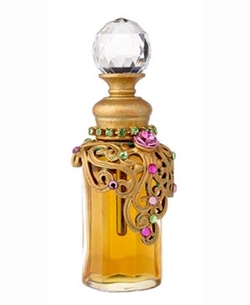
What I like about Rose d'Été (summer rose) and what makes it a distinctive rose fragrance to me is the slight scent of decay that emanates from it. It is not at all a fresh rose but on the contrary it is a rose redolent with all the scents of ripe summer fruits that surround this flower in the imaginary garden evoked by its creator. The way I sense it, it is that antepenultimate time of summer not quite yet that time just before the end of summer. As the fragrance liberates itself from the glass phial there is a very brief moment dominated by fresh notes.Then you are invited to dip your nose into the soft satiny heart of a rose, that part of the flower which retains its scent at the heaviest. According to the description of the notes it is a yellow rose and it smells realistically so...
Continue reading "Perfume Review & Musings: Rose d'Été by Les Parfums de Rosine" »
The color of this perfume is mauve, with brown overtones. It is dark, yet airy. It is like a clear, airy room, maybe decorated with some white marble in which antique polished wooden furniture is to be found, faintly glowing of a warm ambery light, small vases of violets placed atop of them. A soft breeze is blowing through the windows and diffusing the violet scent, mixing it with the polished woods.
Mauve and brown are the colors that for me color Jicky by Guerlain as well. Here I sensed the mauve color before it evoked the smell of violet. It also made me think of lavender, either because it is there or because the mauve color is influencing my perception of the perfume.
I smell lavender, violet, and woods. The scent starts off with a sweet violet note combined with a medicinal accord that seems to comprise camphor wood, perhaps teak wood too. This is soon tempered by the violet becoming more pronounced, softer, and rounder. Then, the perfume becomes more powdery. Finally, the drydown is very woodsy, soft, and warm with new nuances playing out in which I seem to recognize birch wood. There are rich wood accents in this perfume. The final impression I have from this perfume is that of a soft, suggestively powdery veil of violet lingering on the skin.
The violet used in E.Duse is viola odorata Victoria cultivated in Grasse since 1875. It is a very woody violet with a powdery base reminiscent of orris. It was used by Eleonora Duse in a water she would order from Harrods. The perfume was created with the expert advice of historian Alessandra Marini and an Egyptian amber note was added to contribute to the ancient feel of the perfume.
It smells ancient but not in an outmoded way but rather as if you were transported back in time to a quieter world, a world where noisy machines were more easily shut out. It makes me think of the Belle Epoque, of women in a Renoir picture whom I could easily see wearing this perfume. For some reason I also think of Lake Como in Italy, of a room in a hotel by its side, of Eleonora Duse vacationing there in the 1920s. She is preparing to go out for the evening; she dabs on some of this scent before leaving the room and it suits her very well. I find this perfume to be very seductive. The staying power is not impressive, but I suspect that people around you might perceive it better than you. Eleonora Duse or simply Duse (1858-1924) is considered to be the greatest Italian actress of the end of the 19th century. Her fame was only rivalled by that of Sarah Bernhardt whose roles she often played. She was also the first woman ever to grace the cover of Time Magazine on july 30 1923. She and Sarah Bernhardt were rivals for they represented two very different schools of acting. Her own style was very naturalistic and she privilieged being in-character. She is considered by many to be the first modern actor. Her writings also reveal a person with great humanity.
Her acting genius was so much admired by Constantin Stanislavsky that it inspired him to found the Moscow Art Theater in 1897 and to work on the codification of what would come to be known as method acting. He would present her as an ideal point of reference to his students. Through his method we can consider James Dean, Marlon Brando, Natalie Wood, and Robert de Niro for example, to be the heirs to her artistic legacy. You can find a biography of Eleonora Duse by Helen Sheehy here. E.Duse is a limited edition. You can find it at Luscious Cargo for $100 for a 100 ml flacon. Photos from Luscious Cargo and Laura Tonatto's website.
Coeur d'Eté (heart of summer) by Miller Harris starts off as if a garden full of gentle blossoms had suddenly and magically materialized before your eyes and quivering nostrils. You cannot quite make out the colors and the shapes of the flowers but you sense their abundance, their freshness, their loveliness. It evokes for me Claude Monet's Garden being rendered with touches of impressionistic and not so vivid, pastel coloring. A description of the notes in this case does not help capture the personality of the perfume. Coeur d'Eté is seamless, a perfectly woven tapestry of notes that support each others and contribute to the final impression of the perfume. For example, there are chocolate bean and licorice notes in the top notes but they are by no means felt individually. These notes just make the scented music of the perfume soar gently and mysteriously in the air. Sometimes a lilac note or a pear note will emerge fleetingly and fall back into the transparent, calm, and creamy folds of the fragrance. It is to my nose a rarefied and precious juice. The word that best describes its nature in my opinion is "delicate" pronounced softly please.
Coeur d'Eté starts like a beautiful fresh spray of flowers and then becomes slightly warmer and fruitier suggesting the passage from a garden to an orchard. There is also a tinge of the animalic that reminds us of our sexual nature in the midst of all this contemplation. Then, at some point, your skin starts to smell as if you had just stepped out of the ocean. Then, oh unexpected further surprise, you seem to be holding a baby in your arms and smelling its sweet-smelling head. The perfume reveals an extraordinary drydown which only improves with time. It is a superlative skin scent. Lyn Harris composed this perfume while she was pregnant with her first child. Pregnancy is a time in their lives when women develop a heightened sense of smell. The perfume captures very well this experience, in reverse. This is the recreated ideal scent environment of a woman expecting a child, a barrier against the disturbing smells one notices particularly well at that time of life. I would recommend it as an ideal gift for moms-to-be and new moms. Beyond that, this perfume will make a beautiful perfume gift for anyone.
Top notes are chocolate bean, licorice, lemon, grapefruit, tangerine Heart notes are banana, white pear, lilac, cassia, heliotrope Base notes are sandalwood, benzoin, vanilla, fruity musk. A 100 ml bottle retails for $120.
Couture! was released in 2004. Its top notes are bergamot, a hint of pepper, mandarin orange. Middle notes are yellow poppy, jasmine, pomegranate blossom, poppy seeds. Base notes are benzoin, vanilla, and cedar wood.
Couture! opens up with a very soft, sweet, even suave accord, enlivened by citrus as well as slightly peppery notes. It smells distinctive, a good point in the context of a market that privilieges copy-cat perfumes. It is, at the same time, reminiscent for me of the contrast found between citrusy tanginess and a sweet flowery richness in Roma by Laura Biagiotti. Both have prominent citrus in the opening and rich jasmine in the heart notes combined with a warm woodsy base. However, the slightly tart and sickly sweetness found in Roma is much more subdued here. I find that this perfume tends to numb one's nose, so that the closer one gets to the scent, the more this one seems to vanish, with only a ticklish sensation remaining and marking its continued presence. Later, only a waft of air brings back the scent to my consciousness. The perfume is warm without being heavy. It tends however to become harsher in the middle of its development and by that I mean that it smells a bit of Castille soap. "Soapy" is a term that is part of the vocabulary commonly used to describe what I am trying to get at. As far as I know, there seems to be two principal meanings ascribed to that term. Soapy can mean that a certain scent makes me feel as if I had just taken a shower and there is a residual, pleasant soapy/clean smell lingering on my skin. Soapy can also mean that the smell makes you downright think of soap itself, that there's a certain lurking pungency to it that is reminiscent of bathroom liquid soap in public spaces (not of the best kind) and perhaps of Castille soap turned a bit rancid. Yes, "rancid" is the word. It is as if the oils in the soap had degraded. For example, I smell that very characteristically in Tabu by Dana (no offense meant to Tabu fans). Unfortunately, in my view, Couture! has a bit of the rancid type of soapiness. There are probably some aldehydes, although these are not mentioned. Reportedly, certain aldehydes can smell like tallow candles, hence the rancid note. That explains to me also the constant tingling sensation I get when inhaling the scent. However, if I stop deconstructing my sensations I am able to better capture the ensemble. The fragrance is sweet and mellow and evokes fresh petals of flowers after a while. The perfume warms down to a deep and soft drydown which is very pleasant. It is quite vanillic due to the combined presence of vanilla and benzoin as well as very woodsy. The overall impression the perfume gives me is that of a sensual and dressed-up scent, projecting an aura of sophistication which may prove useful to add a little fancy touch to your outfit in the workplace. I see it more as a social perfume meant for others rather than for oneself, that is, a perfume able to send an image of chic and self-control, but which has also the effect of masking your real personality. I don't think I would want to wear it at home, it's too self-conscious of its effects on others and a little bit guarded. In sum, I see it as a more toned-down and updated version of the power-perfume of the 80's (compare with Roma by Biagiotti which was created in 1988). I would still prefer to wear Cinnabar by Estée Lauder for the same effect (Cinnabar's notes are also similar to those of Couture!) because I find it to be more generous, frank, and ample as a perfume, freer. Cinnabar has a richer and better drydown. I also am able to stand aldehydes in Lauder's perfumes much more than in other brands. A perfume for women who need to respect conventions, even for a day, and keep up appearances in public or at work, while sending a message of sophistication.
Photo is from www.fann.cz
Melograno Selvatico means "wild pomegranate" in Italian and refers more particularly here to the pomegranate tree blossom. According to I Profumi di Firenze, the fragrance is based on a 16th century recipe. This is another one in a series of fragrances from their collection which attempts to replicate an antique perfume formula and harks back to the era of the splendor of the Medici. The line is understated (they do not even seem to have a website; please correct me if I'm wrong) but I find their creations to be consistently interesting as often their perfumes present touches of unmistakable individuality.......
Continue reading "Perfume Review & Musings: Melograno Selvatico by I Profumi di Firenze" »
The Duke of Saint Simon recounts in his Memoirs that Louis XIV after having loved perfumes to excess in the first part of his life, and precisely for that reason, was not able to wear them any more in the second part of his existence. Perfumes would trigger excruciating headaches in him, to the point that he had to enforce a formal ban on perfume-wearing at the court at Versailles. Courtiers had to give up fragrances (and grey hats for that matter).
It is said that the only (sly) exception to the rule was the scent emanating from the jasmin-scented gloves of Madame de Maintenon, his second wife united to him through a secret, morganatic marriage. Saint Simon adds that there was however one scent that the king could still smell without becoming ill and that was "la fleur d'oranger" (orange blossom). Would Louis XIV have then approved of the scent created by nose Anne Flipo? Anne Flipo has created numerous perfumes, many of whom are florals. She is the author of L'Artisan La Chasse aux Papillons Extrême and of Poupée by Rochas, among others. I hesitate to say yes and this is why. Having read about the exceptional quality of the Tunisian orange blossom harvest from 2004 on which this vintage perfume is based, it made me think that this scent would be exceptionally delicate and subtle, offering a rich olfactory palette of half-tints and nuances never or rarely experienced before by human mortals. Talk about heightened expectations! First of all, I discover an overture which is strong, even pungent. This is a more brutal opening than I expected. The orange blossom at this stage makes you think of the essence you use in certain culinary preparations rather than of the flower itself. If you know those Iranian sweetmeats made of slivers of pistachio coated with snow-white sugar and perfumed with orange blossom, it is exactly that same scent. They are delicious. I used to love these delicacies but to find this reference in a rare bottle of perfume is a little disconcerting. I would have expected something more sophisticated, complicated, or more natural beauty.
The scent progressively softens down and becomes rounder, smelling more flowery. The sweetness of orange blossom is enhanced by the addition of honey notes. Sometime in the development of the perfume I perceive undertones of wheat and even of wheat bread. At one point, I bump my nose into my wrist and I think, Bois Farine! Mercifully, you can still perceive some citrus notes in the drydown which prevents the fragrance from becoming too sweet.
The evolution of the perfume is fairly linear and should please people who want to get an orange blossom fix. If you are looking for an interpretation of orange blossom, it is not really there. It it not photorealistic either though. it is like a concentrated version of orange blossom. Does it smell good? Yes, but not exceptional. It is also heady and personally, having worn it twice, I twice got a headache. It doesn't agree with me somehow, but I hope it will with you. I dare say Louis XIV would have probably found it too heady. On the other hand, Anne Marie Orsini, princess of Nerola would have probably approved of it. I see her as a stronger supporter of all-out orange blossom. PS: If you dab it lightly it should probably help tone down the perfume. Notes are: orange bigarade, petitgrain, nerolia, honey notes, concreta of orange blossom
You can buy a 100 ml bottle for $250 at Luscious Cargo (2990 copies total were issued.
Photo is from Luscious Cargo.
Sometimes, when you smell certain fragrances, you are reminded that wearing a perfume can be a simple act that weaves itself effortlessly into the quotidian fabric of your daily life. When I breathe perfumes from Les Néréides line in, I think these are good, solid, and trustworthy fragrances that I could see myself getting on my way to the market, because I need to smell good on that day, but not necessarily because I feel I need to add them to my collection of carefully chosen fragrances (I’m really not that way, just imagining this as I am very eclectic by nature and by taste). I imagine stopping by an old-fashioned apothecary or neighborhood perfumery and asking for a bottle of Patchouli Antique, Impérial Opoponax, or Oriental Lumpur. The merchant would tell me that they have just blended Patchouli Antique this very morning. He goes to the back of the store to get it, wipes the flacon with a cloth and hands it to me. I inhale some of its scent lightly escaping from the freshly sealed bottle, recognize a familiar fragrance, exactly the one I was looking for when thinking of wearing patchouli on that day. It smells good and I can tell it is good quality. I tuck it away in my market basket and off I go looking for other aromatic treasures that will perfume my salad and the day.
To me, Les Néréides fragrances allow to recreate an atmosphere that is closer to that moment of intimacy you share with yourself when doing your “toilette”. I think less of the public, of a living room, of a soirée and more of an initial intimate space where you prepare yourself before sailing into the bustle of the day. This is the reason why I imagine Les Néréides flacons sitting on a marble counter in the bathroom, scenting your passage as you step out of the bathroom where you have just performed your daily ablutions. They are not pretentious scents, they only aim at perpetuating a respectable tradition of widely spread know-how concerning perfumes and oriental perfumes in particular in France. They hit the mark and it is their only ambition.
I read somewhere that in Europe, and certainly in France, the family of perfumes that is most favored are orientals, while in the United-States, white florals and clean scents are preferred. Nothing counter-intuitive to me here; I certainly feel that heavier scents are much better tolerated in Paris than in Cambridge and Boston, if these places could be seen as reliable barometers for national tastes.
Patchouli is apparently adored by the masses in France; the last time I traveled to Paris I was struck by how many people seemed to appreciate patchouli, men as well as women. I was all the more struck because my own experience of a national trend in taste in the US is made through the MUA fragrance board and correct me if I’m mistaken, but the majority of perfumistas on MUA seem to find little charm in wearing patchouli. It unfortunately connotes too much of the hemp store, of Woodstock, of the hippie predilection for it, especially as a resource for covering up pot’s smell. Nobody wants to be identified with a grungy hippie, if I may say so. (they were grungy before the grungy movement). So, the 1960s and 1970s are still too vivid in people’s memories so as to allow abstracting from that major scent reference. Shall we call it the patchouli decades? (this is a gross oversimplification because a multitude of perfumes were of course produced at that time.) But somehow, patchouli remains representative of an era and of a social movement.
The 19th century in France was also very patchouliesque. Everybody wore patchouli, you can encounter numerous patchouli references in the novels of that era, in Balzac, Hugo, Flaubert, Zola, and others. Patchouli was often dabbed, not onto the skin, but on handkerchiefs, thus in Les misérables, M. Gillenormand trumpets, “Woman! There is no Robespierre who holds out, woman reigns. (…) the Revolution twisted them (royal scepters) between its thumb and finger like halfpenny wisps of straw (…) but get me up some revolutions now against that little embroidered handkerchief smelling of patchouli! I would like to see you at it. Try!” The supreme seduction of both woman and patchouli is thus conveyed by Hugo. Emma in Madame Bovary also scents her kerchiefs with patchouli to further seduce her lover.
Due to its popularity, patchouli came also to mean an ordinary fragrance in French. When you exclaimed, “cela sent le patchouli!” you could be meaning a) it smells of patchouli, that exotic, earthy-smelling essence coming from Asia and Oceania, b) it smells of a cheap and strong perfume made with patchouli and I do not like it, you’re offending my nose. Once again we see a derogatory association made with patchouli.
The history of its use is fairly recent in Europe. Patchouli etymologically means “green leaf” in Tamil (patchai = green, ilai = leaf). The term in French dates back to 1829 when the plant was first introduced in France. The English adopted the term later, in 1851, via the French.
Despite some of its travails, patchouli is not dead and appears even popular in France. Many perfume lines, both high-brow and low-brow, offer their own renditions of patchouli. When I think of patchouli, I think of literary references, the latest one being the one illustrated by the George Sand (1804-1876) fragrance by Maître Gantier et Parfumeur, a recreation of Sand’s beloved patchouli perfume by nose Nicolas de Barry.
I'm still somewhere in my neighborhood but times have changed, well, maybe not that much. I go to Les Néréides, rue du Four, to sample their perfumes and I take three home with me.The gesture is simple, the prices are reasonable, the scents are good. It is a sensual line, with a dominant of orientals.
Impérial Opoponax is the one that I immediately noticed. It is a very warm, velvety scent, velvety to the point of making you think of caramel. It is sweet, it may evoke root-beer and Coca-Cola to you. Opoponax has natural overtones of lavender, so one is reminded of Musc Ravageur for this reason. A tangy, citrusy note becomes more apparent after the initial outburst of warmth. It warms up further and becomes slightly powdery. The sweetness becomes akin to that of sweet almond in the last stages. It becomes much more powdery in the end. Notes are: Opoponax (sweet myrrh), amber, vanilla, sandalwood, benzoin, citrus…
The structures of Les Néréides fragrances are fairly simple and straightforward. They are good juices, are made with some imagination and have great dry-downs. Patchouli Antique smells very earthy, woodsy, and only slightly sweet. It is strong at first but not overwhelming at all, it keeps itself in check. It feels like you’re embracing a tree in a forest, your nose close up to its bark and mossy patches. Like the other Néréides it warms up very well. With time it loses some of its gravitas to become prettier, lighter, which is an unexpected twist. In mid-course it develops references to a smoky black tea such as Lapsang Souchong and those very earthy black/red tea bricks shaped like wheels that you can sometimes procure in Chinatown. Notes are: Indonesian patchouli, vanilla, musk…
Oriental Lumpur is a spicy and medium-green scent. It is sweetly soft while maintaining a rather transparent texture. Its name evokes exotic merchant counters in Asia -- Lumpur means “straits” in Malay. I see an active, individualistic woman wearing this perfume, someone dressed a little masculine, a white shirt, no jewelry, a black jacket and trousers with a taste for travels and adventure. Notes are: saffron, curry, nutmeg, sandalwood, vanilla, patchouli…
You can buy these scents at Luckyscent for $60.
Photos are from www.luckyscent.com
Pamplelune is part of the Aqua Allegoria line and was composed by nose Mathilde Laurent who is also the creator of Shalimar Light (the 2003 version) and of Attrape-Coeur. It was launched in 1999. Pamplelune offers an original variation on the grapefruit theme. It is a fresh and sophisticated fragrance with a marked presence, some may say, too marked a presence. It is not as light and fruity as some of the other Allegorias. This scent contains certain asperities and it does not compromise with pleasantness. The perfume opens up with a burst of acidic, juicy grapefruit enhanced by other citrus notes like bergamot and petit grain. Some dryness is immediately apparent, I can smell light, dry touches of patchouli. I also detect some mint. Next, the perfume becomes rounder, sweeter, fruitier and a little flowery with the neroli and the blackcurrant notes becoming most apparent to my nose. Then, the sweetness starts receding and a more acrid, austere accord emerges with the fruity grapefruit still in the background but now softened down. It is at this stage that the sulpherous note that is natural to grapefruit and blackcurrant makes its presence felt. The perfumer has chosen to emphasize this aspect of the fruits rather than suppress it, unlike the choice made for Eau Fantasque by Fragonard which also contains both these notes. It is a very astringent and dry, even acrid note, that is not unpleasant, but certainly not easy. Luca Turin proposed a small experiment where he suggested we should try smelling garlic and Pamplelune side by side to catch a whiff of the common sulphur note. Out of curiosity I decided to follow his suggestion and did perceive the kinship between the two but I must say that despite this, I would not say that Pamplelune reminds me of garlic or spring onion. However, Pamplelune does evoke B.O. to me as the drydown progresses. It makes me think of natural musk but since this note is not mentioned, it looks like it is the result of an accord. This odor is very present and becomes more pronounced as the drydown evolves.
Pamplelune is a difficult fragrance to wear in the context of the "deodorized society" in which we live nowadays in the West where body odors are supposed to be masked and an agreable, non-offensive, scented barrier put between you and the rest of society. This trend I would say is particularly strong in the US where the acronym B.O. perfectly illustrates the deep fear most people have of smelling a little too natural, that is bad. In 17th century France, for example, it was not so, people wore perfumes to enhance their natural body odor according to cultural historian Alain Corbin, hence a marked taste for animalic scents such as amber, musk, and civet. Personally, I like Pamplelune because I find it interesting. It goes against the grain of current societal preferences and affirms a personality of its own. Out of the many Guerlain fragrances I smelled one afternoon at their counter, this one stood out (together with Mouchoir de Monsieur and Angélique Noire). I had the opportunity to sniff Grosellina and Tutti Kiwi that same day and didn't like, nor hated them. Earlier today I stopped by The Body Shop and tested their new Rose Cassis. Well, my conclusion is that between smelling controversial and smelling cute (and sickeningly banal in this case), I'll choose the controversial perfume anytime. Notes are: California Grapefruit, Italian Bergamot, Neroli, Petitgrain, Black Currant, Patchouli, Vanilla. You can find a 4.2 oz bottle of Pamplelune for $33.73 at Amazon.com
There is a review of Pamplelune by Cait Shortell available here on Legerdenez
Violetta di Parma by Borsari is a singularly understated masterpiece, yet a true gem. Its fragrance evokes a sentiment of perfection. It is and cannot be anything more beyond itself. It is a deeply satisfying scent in my opinion. How many hours, years, attention, intuition, and sums of intelligence were devoted to reaching this accomplishment, this materpiece of psychological maturity applied to the art of perfumery? One would need to research the archives of the Convento dell'Annunciata in Parma and/or those of the ducal palace of Colorno to understand how the frati worked in collaboration with Maria Luigia of Austria, Duchess of Parma to obtain this subtle violet scent. The perfume is the result of a woman's deep passion for a flower ranging from its scent to its color. We are told that prior to going to Italy to claim her duchy in 1815 she wrote from Austria to her lady-in-waiting in Paris to ask her to procure the flowers in advance, plant them, and make them bloom announcing her intention to engage in the study of botany. Like many of her contemporaries Maria Luigia or Marie-Louise in French (for she was the second wife of Napoleon Bonaparte) was wild about violets but it seems in this case to a degree unparalleled. Many years later, in 1870, Ludovico Borsari succeeded in prying from the hands of the frati dell'Annunciata the secret formula of her beloved perfume and his company has been producing it ever since then. Violetta di Parma starts from a medium-high point suspending its first fresh transparent accord in the air; it is evocative of fern soon revealing small violet flowers coming to the fore and distillating their sweetness in the middle of all the verdancy. It then evokes the fragrance emanating from a few fresh leaves being sensually crushed against each others in the hands of a walker pausing for a moment in the midst of a forest to absorb more profoundly the scents of the trees and of the humid earth. We imagine dewy leaves carpeting the soil of that forest, sometimes sticking themselves onto the walker's shoes at other times falling back onto the ground. We hear the rustling noise made by leaves brushing against the silken hem of a dress. It is cool and it is very early in the morning. The perfume then becomes gradually deeper and softer, warmer, very slightly peppery, a tinge of it really. The perfume goes on to follow its course, becoming subter and subtler until almost achieving..........dematerialization, becoming non-existent. Disappointment may emerge at first. However soon enough you will discover that the scent did not leave your skin, it is still there albeit almost imperceptibly so. It is just taking a pause, gathering its forces after the initial burst of sensations. Now, this is where Violetta di Parma reveals its true nature as a masterpiece in my opinion. I have never encountered a perfume that almost extinguishes itself in such a deliberate way and then comes back, like a tide, as an even deeper, warmer and more radiant fragrance. It is sphynx-like, a mythical human interpretation and understanding of the cycle of life and nature, of light and obscurity, of softly spoken words and silence succeeding to it, one in which one can only hear one's heart beat. If you do not smell it, you cannot see it. It is a moment of nakedness, blankness, and utter simplicity. The first time I wore it I mistakingly thought that my skin, alas, was quenching its thirst by drinking in all the essence contained in the perfume. But then to my surprise I realized perhaps twenty minutes into wearing it that the most beautiful, elegant, and sensual fragrance was scenting the air again around me. Could it be so? Yes, it was unmistakingly developing and evolving further now revealing all of its beauty made more achingly beautiful by the modesty it had revealed and the longing it had provoked. It does unexpectedly so and for a long time as it is tenacious and persistent while maintaining an aura of discretion, softness and subtlety. A veritable tour de force. The creation of a hiatus in this fragrance for me is a mystery. Is it the natural effect of violet essence which is known to put olfactory nerves to sleep, so that one has to smell violets by approaching and then taking away a bouquet of violets further away from one's nose? Or is this natural effect artfully created so as to recreate the phenomenology of the smelling of violets? Is it illustrative of the violet flower's symbolic modesty? Or another possibility yet, is this fragrance imparted a meditative dimension of silence and quiet, unconsciously reflecting the spiritual convent atmosphere of dell'Annunciata? I would like to think so. The fact remains that no additional busy notes were added to cover that moment of retreat of the senses, perhaps another allusion to an experience of religiosity based upon a life of retreat from the world thereby provoking a retreat of the senses through the moral experience of abandonment and chastity.
Be it what it may this highly unusual trait emphasizes the depth of the perfume, its insistence on substance rather than appearance; vulgar, cheap, and showy it is not. You will find it at the other end of the spectrum. That sense of an olfactory pause mimicking muteness and silence is truly rare and precious, unique.
The drydown is again, what other word could we use, beautiful, tanto bellissimo, ever so slightly powdery and creamy, but mostly woody, yet, keeping the transparency, the freshness of a forest brook all along. With time only the fresh stream of transparent water remains. It is a supremely elegant perfume, one that conveys an aristocratic sense of simplicity. I warmly recommend it and think that it should be made part of every odalaphile's collection.
You can find a 3.4 oz spray bottle with atomizer for $35.01 at 99perfume and a 1.6 oz spray bottle without an atomizer for $34 at Luckyscent. As a curiosity, I will post separately a picture of a bouquet of violettes from ca. 1815 containing a secret.
The other day, while trying to conjure up the memory of some of my best-loved hot-weather fragrances of the past, I suddenly remembered Eau de Patou by Patou. How could I have forgotten it, neglected it? It is one of the best hesperidic fragrances that I know of and also one of the best fragrances I've encountered, period. Why? Because it is a superbly fresh fragrance with a definite presence, character, allure, and sophistication. It was created by Jean Kerléo, the then official nose for the house of Patou, who introduced it in 1976. I believe it was reissued in 1991. Sadly, it is now discontinued and hard to find.
Jean Patou is well-known for having introduced the sportswear look for women, having even commercialized the very first tanning oil effective against sunburn in 1927, l'Huile de Chaldée, at a time when tan was becoming fashionable under the influence of Coco Chanel. He also created the knitted swimsuit look and designed the fundamentals of what we have come to consider are the typical tennis or yachting gears. Eau de Patou keeps in line with this philosophy; the blue line on its bottle is a reference to a marine, yachting theme. It is however also a very sexy feminine scent and could be worn both to compliment a casual look or a dressed-up one. May I add that it works very well in a hot, humid climate. I used to wear it in tropical Thailand and I can only remember that it stays faithfully with you, developping beautifully on your skin.
The immediate two dominant notes for me are the citron from Sicily spiced up with pepper, blended together with nasturtium, further refreshed by oranges from Guinea and rounded off by petitgrain. The sexiness comes from the ylang-ylang, the animalic notes, and the spice. There is also rose and sweet honeysuckle in it. It mellows down to a warm base of musk, amber, and moss. Some detect civet and labdanum in it too. It is a wonderful scent that has remained popular despite its disappearance from perfume counters.
On May 14, I will be able to give away a 1 oz bottle of it to the lucky winner of a drawing. I will be fundraising for the Orphan Foundation of America as part of the Benevolent Blogging charity event organized by Katie from Scentzilla and will donate $1 for each comment that you leave under a specific post that I will put up on Mother's day.
Advertisement image is from Images de Parfums
|
bob on
Gai Mattiolo That's Amore Tropical Paradise Tahitian Vanilla & Tahitian Water (2010) {New Perfumes}
: wow, look at that, I'm already drooling, great color, looks superb. how ...
karin on
Parfums de Nicolaï or 3 News for this Spring 2010: l'Eau MiXte, Un Soir en Sicile, New Boutique - Update
: Would love to read an announcement that PdN has updated their website. ...
Trometter on
Are You in the Mood for Oud Aromania? {Trend Alert} + Oud Timeline {Sniffing Suggestions}
: You own a very interesting blog covering lots of topics I am ...
Lucy on
The Popularity of Clover Aroma and L.T. Piver Trèfle Incarnat in Literature and Perfume since the 19th Century - Part 1 {Scented Thoughts (on St Patrick's Day)}
: Wonderful post! I wish there were more clover scents available at this ...
Ruth Ann on
Le De by Givenchy (1957-2007) {Perfume Review & Musings} {New Fragrance}
: I too was so excited that Le De was again available! But, ...
mario on
Like This, Tilda Swinton by Etat Libre d'Orange (2010): Aphrodisiac Pumpkin {Perfume Review} {Celebrity Fragrance}
: Thank you for an excellent back ground on this fragrance.
Lucy on
The Pure White Trend in Fragrances: A Return to Fundamentals {Trend Alert}
: Yes, I agree this is a trend, and I am very much ...
sylvia r. on
Yves Rocher Rose Ispahan {Perfume Review In A Nutshell} {Smell-The-Roses-Till-Valentine's Day Challenge - Day 10}
: Desperate for Rose Ispahan - got it as part of a mini-set. ...
Mitsouko on
EOS for Him & Her (2009): Beer-Based Carbon-Neutral Fragrance Smells of the Future {New Perfumes} {Fragrance News}
: Oh, brilliant! I can't wait to smell like waste and rancid beer! ...
Mitsouko on
In Canada, Perfume Intolerance Mounts in Public Spaces, Honolulu Agrees and The Stinky Bus Trope in Pop Culture {The 5th Sense in the News}
: If there is one thing that I find more obnoxious than stench ...
Linda on
The Quest for The Civet Oil {Ask Marie-Helene & the Readers}
: I forgot to put the anti-spam number in my post so here ...
Linda on
The Quest for The Civet Oil {Ask Marie-Helene & the Readers}
: I too have been searching for the Civet Oil I bought in ...
Theresa on
Kim Kardashian Perfume (2010) {New Fragrance} {Celebrity Perfume}
: I smelled the fragrance in Sephora's and I was quite shocked how ...
Manhattan on
Beyonce Heat (2010) {New Perfume} {Celebrity Fragrance}
: Just purchased this Fragrance today in Manhattan, and I have to say ...
ruby on
Dior Escale à Portofino (2008) {Perfume Review}
: I have brought a bottle for my birthday last year and I ...
- Oriens by Van Cleef & Arpels (2010): Not Just Another Light Perfume {Perfume Review and Musings}
- Parfumerie Générale Gardénia Grand Soir, Bois Naufragé (2010) {New Perfumes}
- Gai Mattiolo That's Amore Tropical Paradise Tahitian Vanilla & Tahitian Water (2010) {New Perfumes}
- Clarins Eau des Jardins (2010): Wear it in Good Health {New Perfume}
- In Memoriam Perfumer Béatrice Piquet (1963-2010): Condolences Space Open
- Blugirl Jus No.1 (2010) {New Perfume}
- John Varvatos Artisan Black (2010) {New Perfume} {Men's Cologne}
- Elizabeth Taylor Violet Eyes by Elizabeth Arden (2010): It Begins with a Look {New Perfume} {Celebrity Fragrance}
- The Popularity of Clover Aroma and L.T. Piver Trèfle Incarnat in Literature and Perfume since the 19th Century - Part 1 {Scented Thoughts (on St Patrick's Day)}
- Prada Infusion d'Iris Eau de Toilette (2010): Fronted by Lara Stone {New Perfume}
- Parfums de Nicolaï or 3 News for this Spring 2010: l'Eau MiXte, Un Soir en Sicile, New Boutique - Update
- Guerlain Release Animated Film for Flora Nymphea {Perfume Images & Ads}
- Humiecki & Graef Bosque (2010): Content in the Company of the Gods {New Perfume}
- Two Scented Toilet Paper Commercials in the Style of Jacques Demy {Perfume Images & Ads}
- Like This, Tilda Swinton by Etat Libre d'Orange (2010): Aphrodisiac Pumpkin {Perfume Review} {Celebrity Fragrance}
- The Pure White Trend in Fragrances: A Return to Fundamentals {Trend Alert}
- Betty Barclay Pure Style (2010) {New Perfume}
- Cowboy-Boot Maker Back at the Ranch Mixes Beauty, Perfume & Fashion Senses {Fashion Notes}
- Viktor & Rolf Order Cake for Flowerbomb's 5th Anniversary at Hotel Le Meurice {Fragrance News}
- Persistent Rumor: Lagerfeld to be Replaced by Elbaz at Chanel {Fashion Notes}
- Drink Tea with Karl, Jean Paul, Naomi etc. {Fashion Notes}
- Demeter Releases Clover Fragrance for St Patrick's Day (2010)
- Lolita Lempicka Eau du Désir (2010): Eau de Cologne & Extrait in One...Who Knew? {New Perfume}
- Paco Rabanne to Launch Feminine Counterpart to 1 Million, with Dree Hemingway
- Etat Libre d'Orange Creates Advertising Visual for Tilda Swinton Scent {Perfume Ads} {Fragrance News}
- Narciso Rodriguez Go Iridescent (2010) {New Perfumes}
- Hermes Voyage (2010): Creativity Pause or A Voyage along Traditional Trails {Perfume Review & Musings}
- It's Official, Madonna will Launch a Material Girl Fragrance in 2011 {Fragrance News} {Celebrity Perfume}
- Jean Paul Goude Talks about the Behind-The-Scenes of Chance Eau Tendre
- Chanel Calls Chance Eau Tendre its Third Generation of the Chance Fragrance Family (2010) {New Perfume}
- You can Win a Kenzoki Set on Twitter until March 15, 2010 {Contests & Giveaways}
- Kenzo Kenzoki Perfumed Beneficial Waters/Eaux Parfumées Bienfaitrices Splash, Fizz, Shh, MMM (2010) {New Perfumes} {Beauty & Olfaction}
- Hanae Mori Sustain Their Efforts in Sustainable Perfumery with No2 (2010) {New Perfume}
- The Body Shop Launches Lychee Blossom/Fleur de Litchi (2010) {New Perfume}
All original content and translations herein copyright © 2006. All rights reserved; reproduction requires the author’s prior written consent. You are however welcome to provide a link back to the posts on this site as long as you explicitly mention their authorship, recognize the original source of the information you give, and acknowledge the site of origin.
Powered by Movable Type 4.32-en
|